
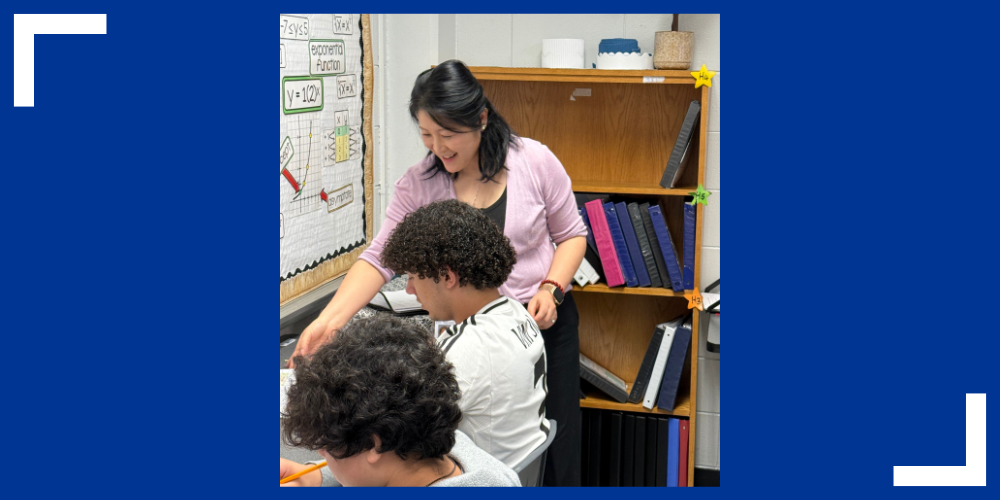
There is no shortage of proverbs about education’s role in producing well-rounded, culturally competent citizens. One such adage says that only 5% of teaching is the dissemination of content, with the remaining 95% consisting of social-emotional learning, empathy and life skills. You would be hard-pressed to find a classroom that fits this mold more perfectly than Hui Couch’s at Newcomer Academy.
Couch’s room is designed to provide the best math learning experience possible. Signs hang from the ceiling to identify where various types of work — independent practice, guided notes and mastery quizzes — should be completed. The walls have reminders on quality work, a "parking lot" for questions, spots for reflection, and jobs and roles listed on the board with students’ photos. Clear, concise and effective — students know exactly what to expect and what to do in Couch’s math classes.
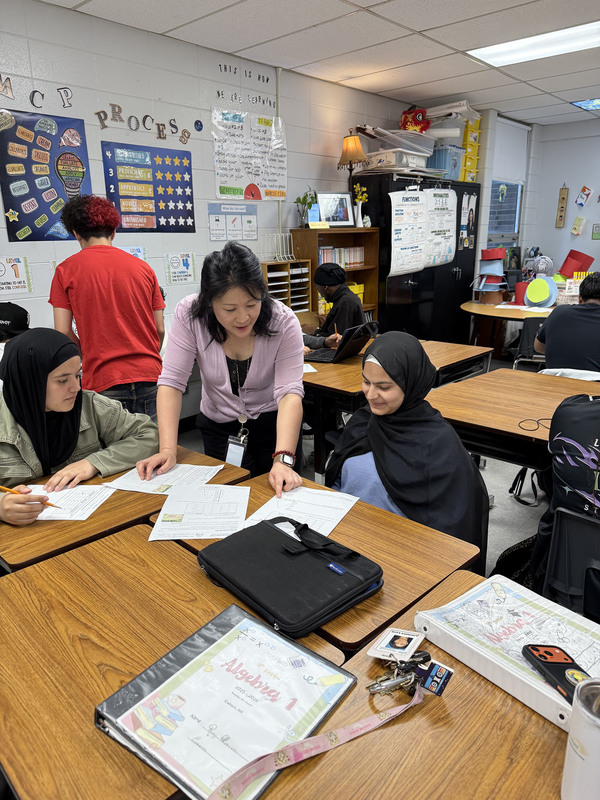
But math is far from the only learning that takes place. In a room full of students learning English, Couch is also a language teacher. In a class of students who have not lived in Jefferson County or the United States for the majority of their lives, she is a teacher of culture. As someone for whom English is not her first language, Couch is a model of perseverance, intentionality and reflection.
For the students in Couch’s classes, her intentionality has produced an environment where all aspects of learning meld together. Students work at a pace and manner that fits their learning styles, using guided notes, peer collaboration and small-group support to understand content before attempting to demonstrate mastery. They have voice and choice throughout the process.
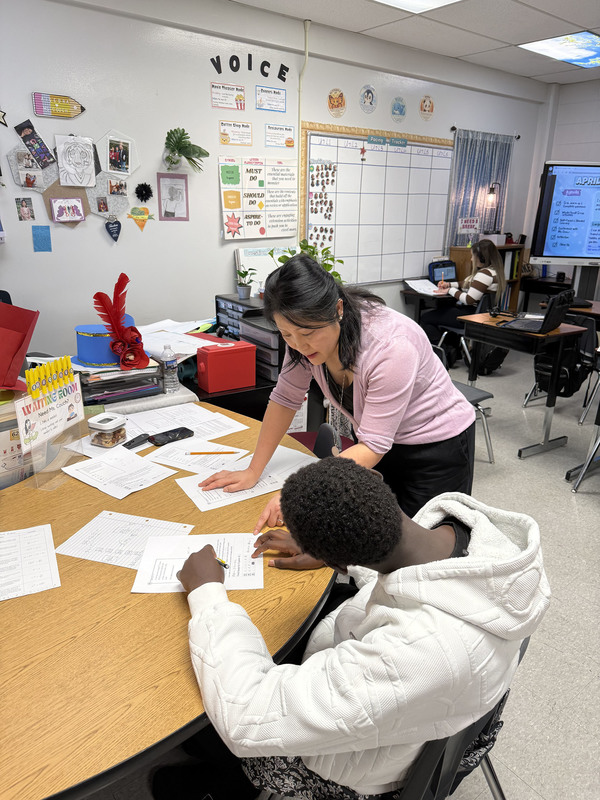
The results of this intentionality are evident. Couch told the story of a student who arrived as a sophomore from another country. He felt confident in math but struggled to express his knowledge in English. After a semester in Couch’s class, he doubled his score on the CERT math assessment. Couch said the confidence the student felt in seeing that growth inspired him and others to continue to excel.
Who can say what percentage of teaching is content as opposed to everything else we do as educators? As far as Couch is concerned, 100% of teaching is the math and cultural support her students need to succeed. In the interview below, she discusses how the National Board Certified Teacher (NBCT) process helped her provide these powerful experiences and how intentional reflection and practice have made her an exemplary teacher.
Why did you choose to become an NBCT?
I chose to become an NBCT because I wanted to grow as a teacher and better support all my students. I saw it as an opportunity to deeply reflect on my teaching practice, strengthen my instructional strategies and be more intentional in how to support all my students’ learning in the classroom.
What was the journey like for you?
It took me two years to complete this journey. In the first year, I worked on Components 2 and 3 together and submitted them in May, then I took the content knowledge test for Component 1 in mid-June. In the second year, I focused on only Component 4, and I was certified in the next December.
It was definitely a challenging process to me, especially since English is not my first language, but it was very rewarding. It really pushed me to slow down and reflect more deeply on my teaching practice. There were times when it felt overwhelming, but I wasn’t alone. Our district provided very strong NBCT professional learning and cohort support, and I also had amazing colleagues and school leaders at Newcomer Academy who supported me throughout this process.
This experience really helped me grow a lot as a teacher. It made me a stronger and more confident teacher.
How has the NBCT process impacted your classroom?
Becoming an NBCT has made me much more intentional in my teaching. I focus more on aligning my instruction with learning targets, standards and assessments, so everything I do has a clear purpose. I’ve also become more reflective. I think more about what strategies are working in my class, what needs to be adjusted, and how I can better engage students in their math thinking and learning.
Since all of my students are multilingual learners, I also pay close attention to how I scaffold and differentiate my instruction to support both content and language. I think about how to support students in closing their learning gaps while still giving them access to grade-level content and
how to extend learning for students who are ready for more challenges. Becoming a NBCT really pushed me to think more about equity, student voice and how to ensure every student has access to meaningful learning.
Why would you recommend becoming an NBCT to another teacher?
I would definitely recommend becoming an NBCT to every teacher because it really helps you grow as a teacher in a very meaningful way. The process is challenging, but it makes you more intentional and confident in your teaching. It helped me better understand how to meet the needs of all learners, especially all my students are multilingual students. It’s also a very rewarding experience. You not only grow professionally, but you also see a real impact on your students’ learning. That’s what makes it worth it.
Now is the perfect time to start thinking about pursuing National Board certification for next year! On Wednesday, May 13th at 5:15p there is a virtual information session about becoming a National Board Certified Teacher in JCPS. You can find this on Vector or reach out to our office for more information.
JCPS offers professional support throughout the school year for NBCT candidates. If you or a colleague are interested in learning more about the National Board Certification process and any of the information mentioned in this article, please contact the Professional Development and Learning Office or review our website at jcps.me/pdl.
professional.learning@jefferson.kyschools.us | 502-485-3415