
Italian mathematician Luca Pacioli, the “Father of Accounting,” famously said, “There is no art without mathematics.” We talk often of the science of teaching that we harness as educators to guide our lessons and work. But there is also an art and creativity with which that science can be expressed; an expert teacher, much like an expert painter or sculptor, utilizes the techniques and strategies that are based in the science of the profession while allowing their art and personality to shine through the work.
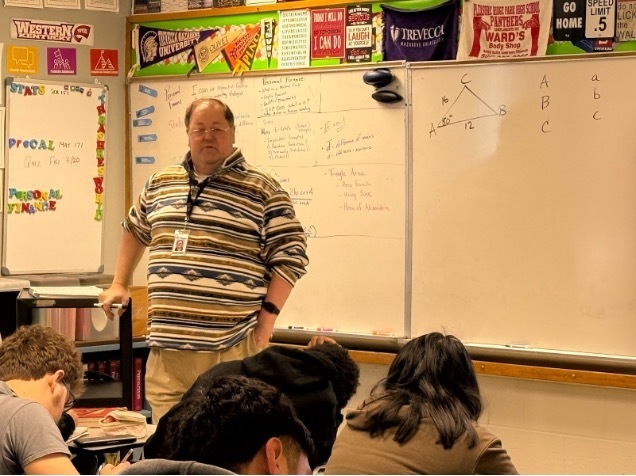
When you step into Matt Thrasher’s classroom at Pleasure Ridge Park High School, there is no denying the presence of his personality—you’re surrounded by it. When you enter Mr. Thrasher’s room, you do so through a door painted to look like a calculator. Myriad signs, phrases, jokes, pop culture references, college pendants, mathematicians and more fill every inch of his classroom. And it works, because the message it sends is clear: “While you’re here, let’s be artists, let’s be mathematicians and let’s enjoy being together.”
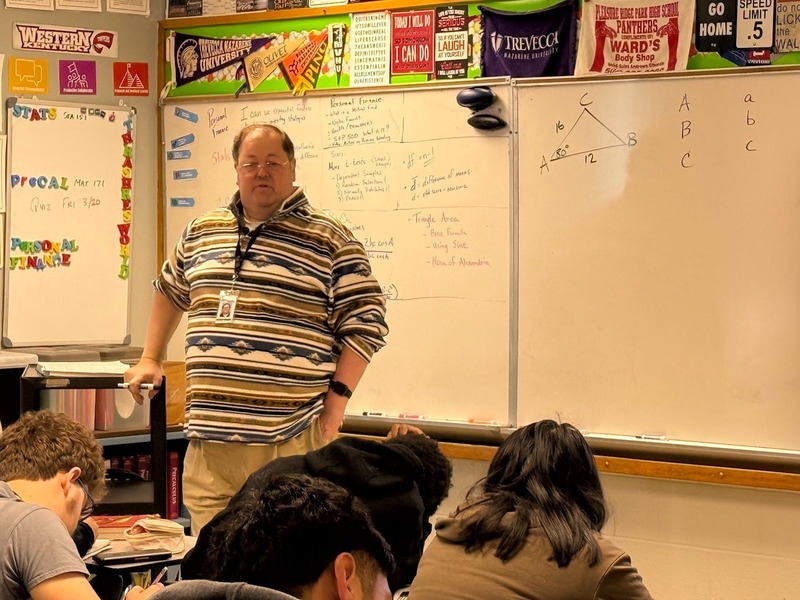
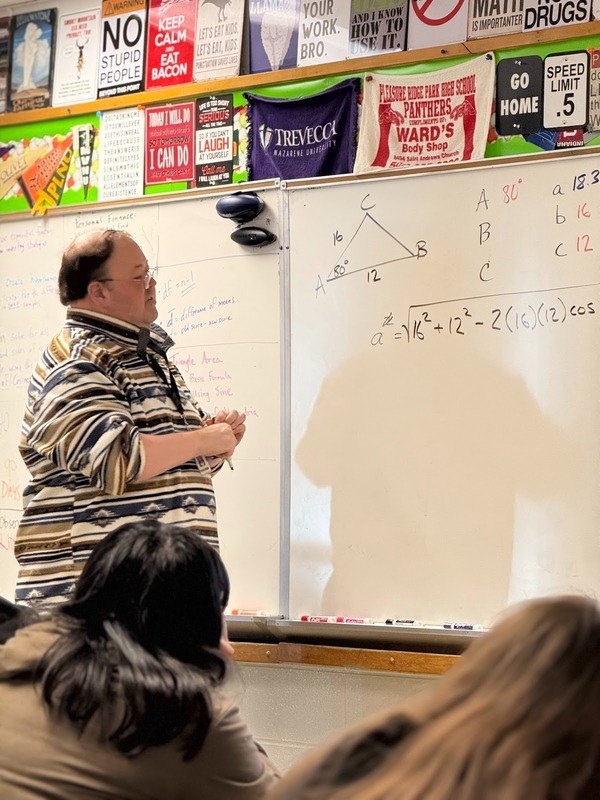
On this front, Mr. Thrasher’s mission has been accomplished. The day’s lesson for Advanced Pre-Calculus involved the Law of Cosines for calculating the side length of a triangle and the use of Heron of Alexandria’s formula for calculating the area of any triangle using only its side lengths. Here we were able to see Mr. Thrasher’s art shine as he guided his students through practice. Students were engaged in the problem-solving process, and whether it was through cold calling or choral response, they had no qualms about providing answers, clues and responses—right or wrong! Math, just like art, is messy.
It was clear in our short time there that Mr. Thrasher’s room is in fact one where math is done amongst those who enjoyed being together. This was because, while Mr. Thrasher’s art was evident in everything around us, the artistry of his students was as well. Whether it was the calling out of a number, a joke about an answer, or a tangent (ahem) about a historic mathematician, all in the room felt comfortable being themselves and pushing themselves to learn. That is all we can ask for in our classrooms, and Matt Thrasher’s ability to be artistic and scientific in his approach to teaching is the driving force behind this excellence.
Becoming a National Board Certified Teacher similarly involves an expert approach to the art and science of teaching. While many teachers find that National Board certification is a pathway to a rank change and increased pay, Mr. Thrasher will be the first to tell you that it isn’t for everyone. In our interview below, you will see how Matt Thrasher’s path to National Board certification might look different than others, but the result remains the same—he is recognized for what he is, an excellent educator.
Why did you choose to become an NBCT?
Part of it was why most people do it: for the pay raise. I had neglected to get my Rank I even though I had been teaching for so many years. I wanted to challenge myself—I have a second Master’s and teach dual credit classes—but I wanted to challenge myself with something different.
What was the journey like for you?
It was strange. I didn’t do it at first for me—there was a group of five or six other teachers that wanted to do it, and I started to do it with them. That group ended up taking too long and had some stumbling blocks along the way, so I ended up doing it on my own. It wasn’t bad! I did the test in the summer one year and then finished the other modules the next school year, so I got it done all at once.
How has the NBCT process impacted your classroom?
I’ve always been someone who looks at data and reflects. The process did help me deepen my tools for reflection, and it did help me look a little bit deeper. Instead of looking at classes as a whole it forced me to look at individual students more. It also helped me look at marginalized students, not just in my class, but throughout the school and helped me examine how to enact change. I’ve worked with student teams and travel organizations and clubs, but I never looked so much at student needs. We had many students who fell under McKinney Vento, some who were in my class—and it really turned a light on for me on how to meet their needs.
Why would you recommend becoming an NBCT to another teacher?
I’m not sure that I would to all teachers because you have to be willing to put a lot of time in. You have to be serious about this process. And you have to be serious about making your classroom the best it can be for students, and that takes a lot of time and work. You also need to know the entirety of your content. For example, if I teach math, I have to know Algebra all the way up to Calculus. It is a lot of time and effort, and if you’re not willing to do that, National Board might not be for you.
Now is the perfect time to start thinking about pursuing National Board certification for next year! JCPS offers professional support throughout the school year for NBCT candidates. If you or a colleague are interested in learning more about the National Board Certification process and any of the information mentioned in this article, please contact the Professional Development and Learning Office or review our website at jcps.me/pdl.
professional.learning@jefferson.kyschools.us | 502-485-3415